
Your website took four months and a serious budget. Custom photography, a considered colour palette, animations that actually run smoothly on a phone.
Your competitor’s site looks like it was built in a weekend. Stock images. A logo that doesn’t scale properly. Three fonts, at least one of them unintentional.
They rank above you for every term that is important for your business. If you are wondering why competitors rank higher when your website looks better, the answer usually has little to do with design.
This is one of the most common frustrations business owners bring to an SEO agency in Australia, and you need a genuine reason for the ranking gap before deciding what to fix. Google doesn’t reward ugly websites. Your competitor didn’t buy their way to the top. And the answer is rarely “you need a new website”.
This quick guide has all the reasons why a website with poor design might be ranking above your visually pleasing website.
Table of Contents
- TL;DR
- A Better-Looking Website Doesn’t Automatically Mean Better SEO
- 8 Reasons Your Competitor Ranks Above You
- Your Website May Be Better Designed but Harder to Understand
- Your Competitor May Have Stronger Topical Authority
- What Changes Now That AI Results Sit Above the Links
- What to Check Before You Redesign Your Website
- Flora Fountain’s Track Record and When SEO Strategy Matters More Than Design
- Find Out Why Your Competitors Rank Higher
- FAQs
TL;DR?
A better-looking website doesn’t automatically rank better. Google evaluates many signals, and visual design is only one small part of the overall experience.
If a competitor with a simpler website ranks above you, check these first:
- Search intent: Does their page answer the question behind the search more directly?
- Content and topical coverage: Do they provide more useful information and cover the topic across relevant pages?
- Technical SEO: Can Google crawl, understand and index their important pages?
- Internal linking and authority: Does their site make important pages easier to discover and demonstrate stronger relevance through connected content and earned references?
A redesign can improve what happens after someone reaches your website, but it won’t automatically fix why they aren’t finding it in Google. Diagnose the ranking gap first, then decide if the website itself needs changing.
A Better-Looking Website Doesn’t Automatically Mean Better SEO
Design and search performance are measured against different things.
- Design is measured against how a page looks and feels to a person already on it.
- Search performance is measured against how well a page serves someone who hasn’t arrived yet and may never have heard of you.
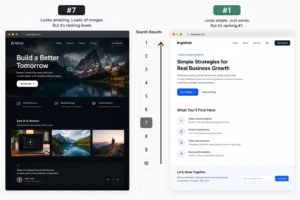
A redesign optimises the second half of the journey. Organic search is the first half.
This matters more than it sounds, because the two jobs can pull against each other. A hero section built around a full-bleed video pushes the actual answer below the fold. A navigation menu designed as a minimal overlay can make individual service pages harder for a crawler to reach. Tight, gallery-led copywriting reads beautifully and leaves out the specifics someone was searching for.
None of that is a design failure. It’s a brief failure. The site was briefed to impress visitors, not to be found by them.
Google is explicit that good scores on the technical side don’t settle the question either. Its page experience guidance notes that strong results in Core Web Vitals reports don’t guarantee top rankings, because there is more to a good experience than those scores, and more to ranking than experience.
So when a plainer site out-ranks yours, the honest interpretation is not “Google has bad taste.” It’s that the plainer site is doing something else better, and that something is usually identifiable.
8 Reasons Your Competitor Ranks Above You
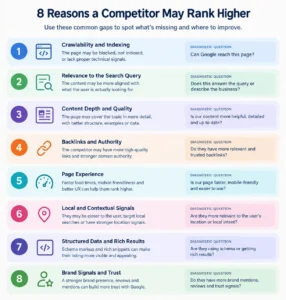
Most ranking gaps between a well-designed site and a plainer competitor come down to eight things: search intent match, content depth, crawlability, internal linking, topical coverage, earned links, real-world page experience and demonstrated expertise.
Each one is checkable. None of them requires a rebuild.
1. Their page answers the query more directly
This is the single most common cause, and the easiest to verify.
Someone in Melbourne searches “how much does a bathroom renovation cost.” Your page opens with a photo gallery, a paragraph about craftsmanship and a contact form. Their page opens with a price range table broken into small, mid and full renovations.
Yours is the better page about your business. Theirs is the better page for that search intent.
Google’s helpful content guidance asks whether someone will leave your content feeling they’ve learned enough to achieve their goal. A gallery doesn’t clear that bar for a pricing query, no matter how good the photography is.
2. Their content goes deeper where it counts
A plumber’s services page that reads “We fix blocked drains fast. Call us today.” is eighty words of nothing. A competitor explaining what causes a blocked drain, what the warning signs look like before it becomes an emergency, what a standard call-out involves and what affects the price has produced something a searcher can actually use.
Google’s guidance asks whether content provides a substantial, complete or comprehensive description of the topic, and whether it goes beyond the obvious. It also warns against the opposite failure: writing to a word count. There is no target length. There’s a target usefulness.
Content quality here means “specificity”, not volume.
3. Google can’t reach half your site
This one catches beautifully built sites constantly.
A custom navigation built as a JavaScript overlay, a services grid where each tile is a clickable div rather than a real link, a filtered portfolio that generates URLs no menu ever points to. Visually flawless. Functionally, several of your money pages have no crawl path to them.
Google is unambiguous about this: links are only crawlable when they use a proper anchor element with an href attribute, and it publishes examples of links it can and can’t parse. A page Google can’t reach is a page that can’t compete, however good it looks.
Crawlability and indexing are not glamorous, but they’re binary. You either have them or you don’t.
4. Their internal linking tells Google what matters
A five-page site where nothing links to anything except through the top nav is a flat structure. A plainer competitor with thirty blog posts, each linking into the relevant service page with descriptive anchor text, has built a map.
Google recommends that every page you care about should have a link from at least one other page on your site, and that paying attention to the anchor text of internal links helps both people and Google make sense of the site
Internal linking is the cheapest ranking work available to most businesses. It requires no new pages, no new budget and no designer. It’s also the work most often skipped, because it doesn’t show up anywhere on a screenshot.
5. They cover the topic and you cover the service
You have one page: “Solar Installation.” They have one service page plus twelve supporting pieces: rebates in your state, panel types compared, what a north-facing roof changes, what happens on a cloudy week, how battery sizing works.
When Google evaluates which page best serves a solar query, one of those sites has demonstrated it understands solar. The other has demonstrated it sells solar.
That’s topical authority, and it’s built page by page over months. It’s also why a competitor who started publishing two years ago is difficult to overtake in a quarter.
6. Other sites reference them and don’t reference you
Backlinks get discussed badly, so let’s be precise about it.
More links do not mechanically equal higher rankings. Google’s spam policies treat link schemes such as buying or selling links that pass ranking credit, excessive exchanges and automated placements as manipulation, and it has spent two decades getting better at nullifying them.
What does help is being worth referencing. A competitor who published original survey data, built a genuinely useful calculator or got quoted by an industry body has earned references that also drive real traffic. That’s a content decision, not a link-buying decision.
If your SEO strategy currently contains a line item for “acquire 50 backlinks,” that’s the wrong shape of plan.
7. Their page experience is better than it looks
Here’s the uncomfortable one. A design-led site frequently loads worse than a plain one, because the things that make it feel premium are heavy: hero video, custom fonts loading late, high-resolution imagery, animation libraries, a carousel that shifts the layout as it initialises.
Google recommends good Core Web Vitals and states plainly that they’re used by its ranking systems, while also noting that perfect scores don’t buy you position one. The three metrics measure loading, responsiveness and visual stability as real users experience them.
That last part matters in Australia specifically. Real users includes someone on mobile data in regional Queensland, not someone on your studio’s fibre connection previewing a staging site. Page experience is measured in the field, not in the mockup.
8. Their content shows a real person did the work
Stock photography, “we are passionate about quality,” no author, no credentials, no specifics. Versus a named tradesperson, a licence number, photos of actual jobs and an explanation of how they handle the situation the reader is worried about.
Google’s guidance asks whether content presents information in a way that makes you want to trust it: clear sourcing, evidence of expertise, background about who’s publishing it. It’s also careful about how this is framed: E-E-A-T (experience, expertise, authoritativeness and trust) isn’t itself a specific ranking factor. Google’s systems use a mix of signals that can identify content demonstrating those qualities, and of the four, it says trust matters most.
That distinction is worth holding onto, because plenty of SEO advice sells E-E-A-T as a dial you can turn. It isn’t. It’s a description of what good content looks like from the outside.
Your Website May Be Better Designed but Harder to Understand
Visual hierarchy tells a visitor where to look. Information hierarchy tells a reader (and a search engine) what the page is about and in what order. A page can have excellent visual hierarchy and almost no information hierarchy.
This is where design-led sites quietly lose ground.
Consider a services page where the H1 is the brand tagline, the section headings are decorative rather than descriptive, the actual service is explained in a hover state and the key differentiator lives inside an image. To a visitor, it’s clear and elegant. To anything parsing the page as text, it’s a well-spaced void.
Google’s key best practices include using the words people would use to look for your content, placed in prominent locations such as the page title and main heading. That’s not a keyword-stuffing instruction. It’s a request to label things accurately.
The test is simple: strip every image and style rule from your page and read what’s left. If the remaining text doesn’t make the subject and the offer obvious, you have a technical SEO and structure problem wearing a design.
Your Competitor May Have Stronger Topical Authority
Topical authority isn’t a score anyone can look up. It’s the practical result of covering a subject properly across connected pages.
The structure that produces it looks like this:
- Service page: the commercial destination that needs to rank
- Supporting content: the questions people ask before they’re ready to buy
- Internal links: contextual links from supporting content into the service page, using anchor text that describes the destination
- Related topics: adjacent questions that expand coverage without cannibalising the same query
The piece you’re reading is an example of the pattern. It’s a supporting page answering a problem-aware question, and it links into our SEO Services in Australia page because that’s the logical next step for a reader who decides the problem is strategy rather than design. If it also happened to be a thin page with an unrelated link jammed into it, it would be the exact thing Google’s guidance warns about.
The reason this compounds is straightforward. Each supporting page has a chance to rank for its own query, each one passes context to the service page, and together they demonstrate coverage. One page can’t do any of that alone.
What Changes Now That AI Results Sit Above the Links
This is the part of the picture that’s shifted most recently, and it makes the “just redesign it” instinct even less useful.
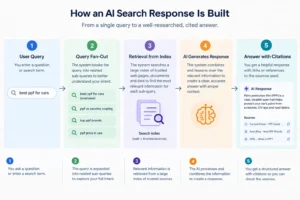
Google’s 2026 guidance for generative AI features in Search confirms that AI Overviews and AI Mode are grounded in its core ranking and quality systems, so standard SEO best practice still applies rather than being replaced. Two details are worth knowing:
- Query fan-out: Rather than answering only what was typed, the system generates related queries and pulls additional results. A site covering a topic broadly has more surfaces to be retrieved from.
- Non-commodity content: Google draws a direct line between generic content assembled from common knowledge and content carrying genuine first-hand expertise, and says the latter is more likely to influence visibility over time.
It also publishes a short list of things you can ignore: llms.txt files, “chunking” content into fragments, rewriting pages specifically for AI systems and chasing inauthentic mentions. Any digital marketing agency in Australia should be able to tell you this without hedging, because Google has published it directly.
The strategic read: the gap between a plain site with real expertise and a beautiful site with generic copy gets wider, not narrower.
What to Check Before You Redesign Your Website
If you take one thing from this article, take this: run the diagnosis before you approve the budget.
A redesign that doesn’t address the actual cause of a ranking gap costs you the build and another six to twelve months. Here’s what to establish first.
| What to check | The question it answers |
|---|---|
| Search visibility | Which queries do you currently appear for and at what position? |
| Indexing | Are all your important pages actually in Google’s index? |
| Search intent | Does each key page match what someone typing that query wants? |
| Content gaps | What is the competitor covering that you aren’t? |
| Internal linking | Does every commercial page have contextual links pointing to it? |
| Technical SEO | Are links crawlable, is the structure clear, is anything blocked? |
| Page experience | What do your Core Web Vitals look like on real mobile connections? |
| Conversion paths | Of the traffic you already get, what proportion converts? |
| Backlink profile | Who references you and is anything there doing harm? |
| Competitor content | What are the top three ranking pages actually doing differently? |
Google publishes its own process for diagnosing drops in Search traffic, and Search Console will answer several of the items above for free.
Run this and one of two things becomes clear. Either the site is fine and the content strategy isn’t, in which case a redesign solves nothing, or the site genuinely is the constraint, and now you know exactly what the rebuild needs to fix rather than guessing.
That’s a materially different brief to hand a designer.
Flora Fountain’s Track Record and When SEO Strategy Matters More Than Design
Design is the right investment when the problem is what happens after someone arrives: people find you, read you and don’t act. SEO strategy is the right investment when the problem is that too few people arrive in the first place, or the wrong people do. Those are different problems with different fixes, and the only way to tell them apart is to look at the data first.
That’s the approach we take at Flora Fountain. We’ve delivered more than 150 projects across SEO, content and broader digital strategy, with more than ten years of hands-on experience diagnosing where a brand’s search performance is actually being held back.
We look at search visibility, content coverage and technical setup before recommending a major change. If the website is fine but the content strategy is the problem, that’s what we’ll say. If the website itself is creating a genuine constraint, we’ll identify what needs to change and why.
That’s the difference between recommending a redesign because the website looks dated and recommending one because the data shows it is affecting performance.
If you want to understand what’s holding your brand’s search performance back, our SEO strategy services start with the same kind of audit outlined above.
Find Out Why Your Competitors Rank Higher
Your competitor isn’t ranking higher because Google prefers their design. The reasons why competitors rank higher are usually much more practical. Their page may answer the query better, be easier to crawl and understand, cover the topic more completely or show stronger evidence of genuine expertise.
Before you invest in another redesign, find out what’s actually holding your search performance back.
At Flora Fountain, we analyse your search visibility, content coverage, technical setup and competitor rankings to identify where the gap is and what needs to change.
Get your SEO strategy assessed before you spend more on a website rebuild.
Talk to Flora Fountain and let’s find out what’s keeping your competitors ahead.
FAQs
1. Can a website rank well even if it looks outdated?
Yes. Google’s ranking systems evaluate a mix of factors including relevance to the query, content usefulness, crawlability, site structure and page experience. Visual design isn’t assessed directly, so a plain page that answers the query well can outrank a more polished page that doesn’t.
2. Does Google rank websites based on design quality?
Not directly. Google states there is no single page experience signal and that good Core Web Vitals scores don’t guarantee top rankings. Design influences ranking only indirectly, through things like loading performance, mobile usability and how clearly the main content can be distinguished
4. Will redesigning my website improve my Google rankings?
Only if the current site is the actual constraint. If the ranking gap comes from search intent mismatch, thin content, weak internal linking or missing topical coverage, a redesign won’t address it. Diagnose first: Search Console will show which pages are indexed and which queries you appear for before you commit any budget.
5. Do backlinks still matter for rankings in 2026?
Relevant, naturally earned links still help Google discover and contextualise pages. But Google’s spam policies treat buying, selling or automating links as manipulation, and its systems are designed to nullify them. Creating something genuinely worth referencing is the only version of this that works reliably.
6. Is E-E-A-T a ranking factor?
No. Google states that E-E-A-T itself isn’t a specific ranking factor. Its systems use a mix of signals that can identify content demonstrating experience, expertise, authoritativeness and trust, and it describes trust as the most important of the four.
7. How long does it take to outrank a competitor?
It depends on the size of the gap. A search intent mismatch on an existing page can shift within weeks. Closing a topical authority gap against a competitor with years of published content generally takes several months of consistent work, and anyone promising a fixed timeline without auditing your site first is guessing.
