
If your advertising budget keeps climbing but the number of new customers walking through the door isn’t keeping pace, the problem probably isn’t that you need more leads. It’s that your acquisition system is costing too much per customer, and that number tends to hide in plain sight until someone sits down and actually works it out.
This is where customer acquisition cost becomes worth understanding properly, not as a vanity figure for a monthly report, but as a diagnostic that shows exactly where the money is leaking.
At 30 June 2026, the Australian Bureau of Statistics counted 2,814,778 actively trading businesses in the Australian economy. Based on the ABS’s own employment-size breakdown, roughly 2.74 million of them, close to 97%, employ fewer than 20 people, the threshold the ABS and the Australian Small Business and Family Enterprise Ombudsman use to define a small business. Most of that group is also competing for customers across more channels than a few years ago: 51% of Australian businesses used social media for their online presence in 2024–25, up from 47%, and 32% took orders online. For an SME competing in that crowded, fragmented market, reducing CAC isn’t about spending less. It’s about making the money already being spent work harder.
Table of Contents
- What Is Customer Acquisition Cost?
- Why CAC Can Rise Even When Your Campaigns Are Generating Leads
- 7 Practical Ways Australian SMEs Can Reduce CAC
- Stop Measuring Marketing by Leads Alone
- When Performance Marketing Helps Reduce CAC
- A Simple CAC Audit for Your Business
- What a Sustainable Acquisition System Looks Like
- Frequently Asked Questions
What Is Customer Acquisition Cost?
Customer acquisition cost is the total amount a business spends to acquire one new customer:
CAC = Total acquisition cost ÷ Number of new customers acquired
| Industry | General CAC Range |
|---|---|
| Local Services | $50–$300 |
| SaaS | $200–$1,000+ |
| Ecommerce | $20–$150 |
| B2B Services | $300–$2,000+ |
“Total acquisition cost” should include everything that goes into winning that customer: ad spend, platform or agency fees, the sales team’s time and any tools used along the way, not just the media budget.
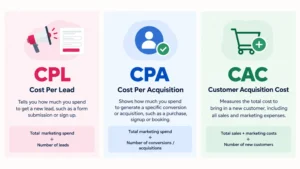
- Cost per lead (CPL): what it costs to generate one lead, regardless of whether that lead ever buys.
- Cost per acquisition (CPA): the cost of one specific conversion action, such as a form fill or a call, also regardless of whether it becomes revenue.
- Customer acquisition cost (CAC): what it actually costs to turn that interest into a paying customer.
A campaign can post an excellent CPL and a poor CAC at the same time. That gap is usually where the real waste is hiding.
Why CAC Can Rise Even When Your Campaigns Are Generating Leads
A rising customer acquisition cost rarely means the campaigns have stopped working. More often, it means one of the following is happening underneath the numbers:
- You’re optimising for leads instead of customers: A campaign can hit its lead targets every month while the sales team quietly struggles to close any of them.
- Maybe your conversion rate is too low: More traffic through a leaky funnel can mean higher acquisition costs without more customers.
- Leads aren’t qualified: Volume goes up, and so does the sales time spent on people who were never going to buy.
- Your targeting is too broad: Casting a wider net catches more low-intent clicks along with genuine prospects.
- Landing page is leaking conversions: Traffic arrives, but the page gives people no clear reason to act.
- Your channels are judged separately instead of together: A channel that looks “expensive” on its own might be doing most of the work earlier in the buying journey.
7 Practical Ways Australian SMEs Can Reduce CAC
None of what follows is about cutting spend outright. It’s about spending the same amount, or less, more deliberately.
1. Bid on Outcomes, Not Clicks
Google’s own Ads documentation recommends aligning your bidding strategy with the actual business goal: Target CPA when the goal is a conversion at a set cost, and Target ROAS (or Maximise Conversion Value) when what that conversion is worth matters more than the volume of them. Optimising purely for clicks or impressions can hit its own targets while doing very little for CAC, because clicks and conversions aren’t the same currency.
- Check: Which bidding strategy each active campaign is actually running on
- Change: Move qualifying campaigns from manual or maximise-clicks bidding to Target CPA or Target ROAS once enough conversion data is feeding them
- Metric to watch: CAC by campaign, not cost per click
2. Cut Wasted Spend at the Targeting Level
Irrelevant search terms, low-quality placements and audience targeting that’s broader than it needs to be all quietly inflate CAC without showing up as an obvious problem in the top-line numbers.
- Check: Search term reports, placement reports and audience segments for the last 90 days
- Change: Exclude irrelevant terms and placements, and tighten segmentation around the audiences that have actually converted before
- Metric to watch: Percentage of spend going to search terms or placements with zero conversions
3. Improve Your Conversion Rate Before Increasing Ad Spend
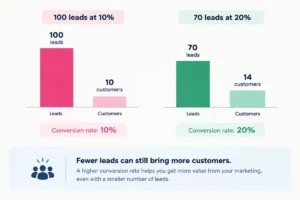
100 leads converting at a 10% close rate produce 10 customers. 70 leads converting at a 20% close rate produce 14 customers, from fewer leads and likely less ad spend. This is why CAC can’t be treated as purely an advertising metric. Improving conversion at any single step, a clearer landing page, a faster sales follow-up, a sharper offer, tends to move CAC further than adding more traffic to the same leaking process.
- Check: Conversion rate at each step from click to lead to sale
- Change: Fix the weakest step first rather than the one that feels most visible
- Metric to watch: Overall lead-to-customer conversion rate, not just traffic volume
4. Score Leads for Quality, Not Just Volume
A campaign generating 100 leads at $40 each can look better on paper than one generating 50 leads at $60 each. But if the first produces 3 customers and the second produces 10, the cheaper cost per lead is misleading. CPL is not CAC, and a business that only tracks CPL can end up quietly defunding its best-performing channel.
- Check: How many leads from each channel actually become customers, not just how many are generated
- Change: Report on cost per qualified lead and CAC by channel, alongside CPL, not instead of it
- Metric to watch: Customers per channel, not leads per channel
5. Fix the Landing Page Leak
Traffic that arrives and leaves without converting is money spent for nothing. A page with a slow load time, a confusing offer or a form that asks for too much too early will quietly raise CAC no matter how well-targeted the traffic is.
- Check: Bounce rate and form completion rate on the page each campaign sends traffic to
- Change: Simplify the offer and the form, and make the next step obvious within the first screen
- Metric to watch: Landing page conversion rate by traffic source
6. Judge Acquisition Channels Together, Not Separately
A channel that looks expensive in isolation, paid social, for example, might be introducing prospects who later convert through organic search or a branded search a few weeks on. Judging each channel purely by its own last-click CAC can lead to cutting the channel that was quietly doing the early-stage work.
- Check: The full path prospects take across channels before they convert, not just the last click
- Change: Look at assisted conversions and multi-channel paths before cutting a channel based on its standalone number
- Metric to watch: CAC calculated across the full acquisition path, not per channel in isolation
7. Fix Conversion Tracking Before Touching the Budget
None of the above works if the platform doesn’t know what a real conversion looks like. Campaigns optimised around the wrong action, a page view instead of a genuine enquiry, will keep spending efficiently toward the wrong outcome.
- Check: What each campaign is actually counting as a “conversion”
- Change: Connect tracking to a qualified action, a genuine enquiry or a completed call, not just a click or a page load
- Metric to watch: the gap between reported conversions and actual sales-qualified leads
Stop Measuring Marketing by Leads Alone
Lead volume on its own is a vanity metric unless it’s tracked through to what actually matters. The real chain worth watching is:
traffic → lead → qualified lead → sales conversation → customer
Each step in that chain has its own conversion rate, and CAC is the compound result of all of them, not just the first one. A business reporting only on leads generated is measuring the easiest number to move, not necessarily the one that reflects growth.
When Performance Marketing Helps Reduce CAC
Performance marketing can be genuinely useful once campaigns are tied to measurable business outcomes, cost per qualified lead and CAC by channel, rather than judged purely on impressions or clicks. Once conversion tracking, lead qualification and landing pages are actually working together, performance campaigns have something accurate to optimise toward, and marketing ROI starts reflecting real revenue instead of surface-level activity.
For businesses that want a second set of eyes on where their acquisition spend is actually going before committing more budget, Flora Fountain’s performance marketing team works from exactly this kind of data before recommending any change.
A Simple CAC Audit for Your Business
This doesn’t need a dashboard overhaul. Seven questions, answered honestly, usually surface where the CAC problem actually sits:
- What did you spend, in total, across every channel and platform fee?
- How many genuine leads did that spend produce?
- How many of those leads were actually qualified?
- How many turned into a real sales conversation?
- How many became paying customers?
- Which channel produced those customers, not just the leads?
- What did those customers generate in revenue?
Working through those seven answers turns CAC from an abstract number into a specific, channel-by-channel picture of where the money is working and where it isn’t.
What a Sustainable Acquisition System Looks Like
Reducing CAC long-term isn’t a single fix. It’s paid acquisition, SEO, the website and conversion tracking all feeding into each other instead of running as separate, unconnected line items. A campaign can only be as efficient as the tracking behind it, and a landing page can only convert as well as the offer and the traffic quality allow.
With more than 150 completed projects and a team carrying over a decade of hands-on experience across paid, organic and conversion work, this is the kind of connected thinking Flora Fountain brings to a CAC problem, built on the specific numbers for that business rather than a generic promise of higher ROI. Get in touch with our team if you’d like a second opinion on where your acquisition spend is actually going.
Talk to Flora Fountain About Your Numbers
If your acquisition numbers don’t add up the way they should, the fix is rarely “spend more.” It’s usually a specific leak somewhere between traffic and revenue. Our digital marketing team can help you find exactly where.
Frequently Asked Questions
1. How is the CAC calculated?
CAC is calculated by dividing the total marketing and sales costs by the number of new customers acquired during the same period.
CAC = Total marketing and sales costs ÷ Number of new customers acquired
For example, if a business spends $10,000 on marketing and sales and gains 200 new customers, its CAC is $50 per customer.
2. What is CAC and CTR?
CAC measures how much it costs to acquire a new customer, while CTR (Click-Through Rate) measures the percentage of people who click an advertisement or link after seeing it.
For example, an ad with 10,000 impressions and 500 clicks has a 5% CTR. If those clicks ultimately generate 10 customers and the total acquisition spend is $1,000, the CAC is $100 per customer.
CTR = Clicks ÷ Impressions × 100
CAC = Total acquisition costs ÷ New customers acquired
3. How can I lower CAC without cutting my ad budget?
Focus on conversion rate, lead qualification and tracking accuracy before cutting spend. A lower budget spent on the same leaking funnel usually just produces fewer total customers at a similar cost per customer. Fixing the leak first, then adjusting spend, tends to move CAC further than a budget cut alone.
4. Does customer acquisition cost apply to organic channels like SEO?
Yes. Any channel that requires time, tools or money to attract a customer contributes to CAC, including SEO and content, even though the cost there is mostly time and resourcing rather than direct media spend.
